
The Other Resurrection
John 11: Lazarus, Jesus, and more

For most of 2025 this blog reviewed the Gospel of Luke, noting that at least some of its contents could rightly be considered ‘constructed narratives,’ that is, stories that its author (known as Luke, but in fact, anonymous) constructed in order to support a particular view of Jesus, his ministry and his message.
Since January of this year we have focused on the Gospel of John (likewise an unknown author), this time with a particular interest. While Luke used the language of ‘kingdom’ to describe the community Jesus’ people would inhabit, John used the phrase ‘eternal life’ to indicate the kind of life followers are invited to enjoy.
In both cases, it is a quality of life that is marked by inclusion in the form of hospitality, healing by means of compassionate presence, transformation in the form of metanoia, and a commitment to justice in the face of empire.
And in John, it is a life that is not limited by physical death, but persists beyond any mortal limits we believe we endure.
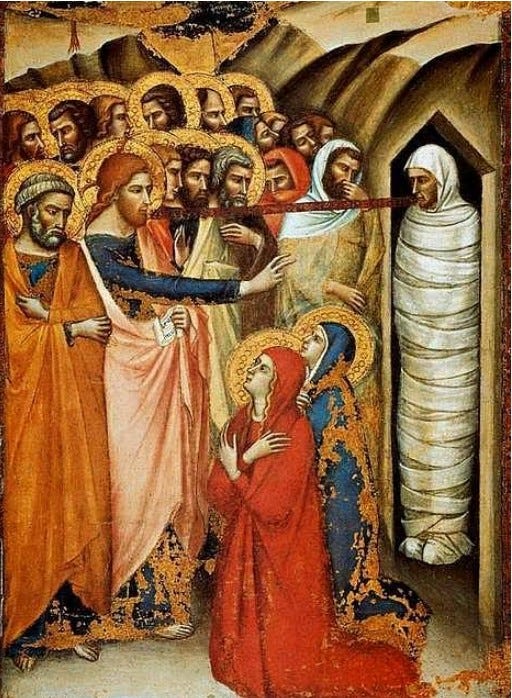
Because this series has not addressed the whole of the Fourth Gospel, we have not included the notion of ‘constructed narrative’ here. But it is clear, especially in the case of chapter 11, the raising of Lazarus, that this gospel has been carefully constructed to point to resurrection as the heart of Jesus’ being among us.
The first clue to the constructed nature of this story is that it only appears in this last gospel, in spite of there being references to many people as witnesses to this amazing event. The text notes that there were ‘Jews’ with the sisters of Lazarus consoling them at home, and others who accompanied them to the grave itself. At the moment Jesus is about to call Lazarus out he prays to God saying, “I have said this for the sake of the crowd standing here, so that they may believe that you sent me.” And the gospel then reports that ‘many’ who were witnesses came to believe in Jesus.
How could such an astonishing gesture, the most compelling of the seven ‘signs’ or miracles recorded in this gospel go completely unnoticed and unremarked by the other three evangelists? Impossible.
There are further clues in the text that point to what I believe is the purpose behind this constructed narrative. First, Jesus tells his friends that this “illness” (in Greek, astheneó, weakness) will not lead to death, but to a manifestation of God’s glory. Revealing God’s glory at work in Jesus was the purpose of all of the signs John records; it is also the truth that will be displayed when Jesus himself rises from death. Other gospels record Jesus experiencing a moment of weakness in the Garden of Gethsemane; is this, perhaps, the equivalent for this gospel?
Next, as Jesus discusses with his disciples whether or not to go to Bethany to be with Lazarus and his sisters, he, and they, acknowledge that if he is seen near Jerusalem his own life will be at stake. In facing Lazarus’ ‘weakness’ and death, he knows he will face his own.
And finally, the critical revelation takes place in the conversation between Jesus and Lazarus’ sister, Martha:
Jesus said to her, “Your brother will rise again.” Martha said to him, “I know that he will rise again in the resurrection on the last day.” Jesus said to her, “I am the resurrection and the life. Those who believe in me, even though they die, will live, and everyone who lives and believes in me will never die.”
In short, I suggest that John here has constructed the narrative of Jesus raising his beloved friend both as a mirror image of what Jesus himself will enact, and as a promise that resurrection will be available for all who believe in him.
It is useful to note that there are other ‘raisings’ in the Bible, both the Hebrew Bible (Old Testament) and Christian Canon (New Testament).
~ Elijah and Elisha each raise the sons of women who had offered them hospitality: Elijah the son of the widow of Zarapheth, a poor Gentile woman (1 Kings 17), and Elisha the son of a wealthy Israelite woman in Shunem (2 Kings 4).
~ The Gospel of Luke reports two ‘raisings,’ one of the son of a widow (ch 7), and one of the daughter of a leader of a synagogue (ch 8). Interesting to compare these two to the two from the Hebrew Bible (Old Testament) - one the son of a widow, and the other the child of an influential person.
~ The Gospel of Matthew records a conversation in which followers of John (Baptizer) ask whether Jesus is the Messiah. Jesus answered them, “Go and tell John what you hear and see: the blind receive their sight, the lame walk, lepers are cleansed, the deaf hear, the dead are raised, and the poor have good news brought to them.” All of his works, including healing, raising the dead, and preaching good news to the poor, are evidence of Jesus’ identity. (Mt 11:4-5)
~ Peter and Paul each raise members of the early church, Tabitha and Eutychus, recorded in the book of Acts, chapters 9 and 20. These may represent yet another pair, parallels to Elijah and Elisha, as well as the two in Luke.
So the Fourth Gospel writer had ample material to work with in crafting a narrative that presents the power and glory of God manifest in Lazarus’ return to life, to the love of his sisters and the witness of his community. This was not a one-off moment, a chance for Jesus to show his personal sorrow and devotion to his friend. This act was one in a series of acts in which God’s power to bring life out of things or persons who appear to us to be dead and buried is on display. And if we note the paired raisings in 1 & 2 Kings, Luke, and Acts, perhaps it is fitting for John’s gospel to pair Lazarus and Jesus, one whose name, El-azar, means ‘God helps,’ and the other, Yeshua, meaning ‘God saves.’
The church remembers the raising of Lazarus just before Holy Week, a sign of Jesus’ power over life and death. It is presented as a foretaste of something even more impressive — the grand celebration of Easter Sunday, the day when we lift up Jesus’ own resurrection. And yet, is it not all of a piece, this resurgence of life in the face of all that would destroy our lives, our loves, our dreams? Is it not the very foundation of God’s promises - to Israel, to the Church, to each seeker of grace - that life will always triumph over the forces of death and destruction?
Our resurrection, our eternal life, is happening here and now, if we choose to believe that this is possible, that Christ is, in fact, the Messiah sent by God to impart this new way of living to any who willingly receive it.
So here is the lesson for today—for every day lived in union with Christ—that death is never God’s last word.
That in the story of Lazarus, in the raising of the sons and daughters of believers and non-believers, in the grand resurrection of Easter Sunday, we are assured that while death is inevitable, it is not final.
That in Jesus’ conversation with Martha we are assured that resurrection is not something that is scheduled for some distant day and time, but is present in Christ wherever and whenever he himself is present.
That the promise of eternal life, of membership in a Community of Grace, of life lived in and with and for each other, is available in every moment, if only we will choose it.
May the resurrection become a present reality, a chance for eternal life, for you, this day and always.
🙏🙏
May you always look through Easter-tinted lenses when you see the world.