
A Chat with Nicodemus
our first look at 'eternal life'

Welcome to the second installment of this study of the Gospel of John and its use of the terms “life” and “eternal life.” Having concluded in a study of the Gospel of Luke that “kingdom” was a convenient term of reference for the time, but not really what Jesus was trying to establish, I am turning first to John, then to the Epistles of Paul to tease out other ways of characterizing life as a follower of Jesus.
The first installment began right at the beginning of this gospel: In the beginning was the Word, and the Word was with God, and the Word was God. In this passage both “light” and “life” came into being through this Word. Then the Word took on flesh, and was filled with glory, and shared that unified nature - flesh + glory - with anyone who would receive and trust in that revelation.
The next time we encounter the word ‘life’ in this gospel is in the third chapter, in a scene in which a Jewish leader named Nicodemus approaches Jesus in the night time. There are some striking images at work in this passage, and I want to lay a few of them out here.
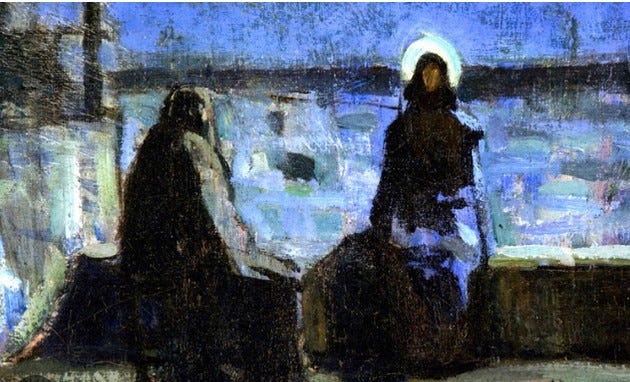

First, Nicodemus approaches Jesus, not with a question, but with an observation, or perhaps a belief, that one who does what Jesus does must have God with him. The Greek here is meta, meaning accompanying or alongside. Given what was said at the very beginning of this gospel - that the Word was with God, and the Word was God - Nicodemus’ first, well-intentioned statement is revealed to be mistaken. In this gospel, Jesus doesn’t live alongside God, Jesus is one with God.
Then comes Jesus’ deeply enigmatic response: Very truly, I tell you, no one can see the kingdom of God without being born from above.
Notice that it’s Jesus who brings up the phrase, kingdom of God. Here and a couple of verses later are the only places in this gospel where this phrase, so frequently used in Matthew, Mark, and Luke, shows up. I suggest that it appears here as a metaphor for God’s self - that we are intended to hear Jesus say, ‘…no one can see God without being born from above.’ There’s nothing in this gospel that suggests that there’s any kind of actual realm under discussion. The notion of a ‘kingdom’ only shows up again when Jesus is interrogated by Pilate, a setting in which Jesus explicitly rejects any kind of royal role.
The word for ‘from above’ is anothen, often translated ‘again’, as in ‘born again.’ And while both are legitimate translations, additional options include ‘from the beginning’, and ‘anew.’1 I am especially intrigued by the options of ‘anew’ and ‘from the beginning.’ They invite one to think about that first chapter again, where the Word enters into the world bringing something entirely new - light and life - and offers them to any who will accept them.
One might imagine Jesus here is setting up a contrast between one kind of life and another, between living alongside the Divine, and being completely intertwined with it, immersed in it.
What follows is a back and forth between Jesus and Nicodemus in which a series of contrasts are played out:
Above/Below — Flesh/Spirit — Birth/Old age — Womb/Water — Earth/Heaven
And while Nicodemus is puzzling about birth, womb, and flesh, Jesus is pointing out that the birth that is from above, from Spirit, from water, from heaven (ouranos, skyward or celestial) is what produces ‘eternal life.’ Stuck in the earthly, tangible side of the equation, Nicodemus does not see that there is something much larger at stake.
Which brings us to a verse that is, perhaps, one of the best known in all of Scripture: ‘For God so loved the world that he gave his only Son, so that everyone who believes in him may not perish but may have eternal life.’
Taken on its own, that single statement seems to suggest that if we just ‘believe in’ Jesus we will never die. But single statements from any part of Scripture, and particularly from this gospel which is so rich in layered meanings, cannot capture the full import a verse.
“Eternal (aiṓnios) life operates simultaneously outside of time, inside of time, and beyond time – i.e. what gives time its everlasting meaning for the believer through faith, yet is also time-independent.”2
This statement is pointing to a quality of life that is available here and now, not to prevent us from dying (that much should be clear) or in some everlasting afterlife. It is a ‘more than’ kind of quality, something that is given freely - as freely as the wind blows - to all who are ready and willing to be born into something more than just earthly, fleshly existence.
Jesus goes on to explain why the Son was sent by God into this world of earthly flesh. ‘God did not send the Son into the world to condemn the world but in order that the world might be saved through him.’ ‘Saved’ here comes from the Greek root, sozo, meaning to heal, to rescue, to lift up and redeem the simple earthly lives we live. And ‘believe’ comes from pisteuo, to receive, to accept, to trust completely.
Eternal life, then, is the new way of being, not built around kingship or power, but around life itself, around Spirit and breath and light, and around the One who came to share all of that with humanity.
How, then, does this way of being speak to the needs of mortal folk in this world? To those who suffer, in simple ways and scary ways? To those who are alone, who face new challenges, whose lives feel limited, with fewer days ahead than behind?
Perhaps this way of being, this eternal life, has the power to enlarge us past the limitations, the cares and concerns, the aches and pains, the fear of coming to an end without having begun, that hold us hostage.
Accepting the life of Spirit within the flesh, believing and trusting that there is a crucial ‘more than’ to my own life and to the lives of others, opens a path to healing at a deep, more-than-flesh level. It pushes me to look past the cold that’s keeping me out of work this week, and the surgery that’s planned for a month from now.
It pushes my focus past the immediate chaos of personal and societal life, to consider at least the possibility that there are ways in which Spirit and glory and the life given from above may be present in the midst of everything that feels so pressing. Not by-passing the hard stuff, but enlarging the field of vision, holding it all together in trust that we might find meaning, or at least a way forward.
It pushes me to see that while it is incredibly important to do what we are called to do and able to do, that the results don’t rest in our hands. That we don’t have to clutch for evidence or progress or triumph. That we can do our best, then rest and trust that while evil (or its very much smaller cousins, sickness, old age, and death) may have its hour, that life and Spirit and glory are higher and stronger and hold the power to heal all that afflicts us.
I am enthralled with this series.. thank you again Beth for your words and wisdom!
I’m also taken with the born anew and from the beginning translation options. This is such a rich piece!